
If everything goes as planned, NASA astronauts will orbit the moon again in 2026.

The Artemis II mission, potentially launching in February, aims to send four astronauts to the moon, although they will not set foot on its surface.
If everything proceeds as per NASA’s schedule, 2026 will be the year astronauts will once again travel to the moon.
In just a few months, four astronauts are set to orbit the moon on an approximately 10-day journey — the nearest humans have been in over fifty years.
The mission, termed Artemis II, may launch as soon as February and would serve as a highly anticipated boost to the U.S. efforts to return to the moon. The mission will act as an essential evaluation of NASA's next-gen Space Launch System rocket and Orion spacecraft, which have been in progress for over ten years and encountered numerous delays and significant budget excesses. The system has not previously transported a crew.
Returning to the moon has been a focus for President Donald Trump since his initial term, and the present administration has increased its emphasis on excelling in the escalating space competition between the U.S. and China. Chinese authorities have committed to sending their astronauts to the moon's surface by 2030.
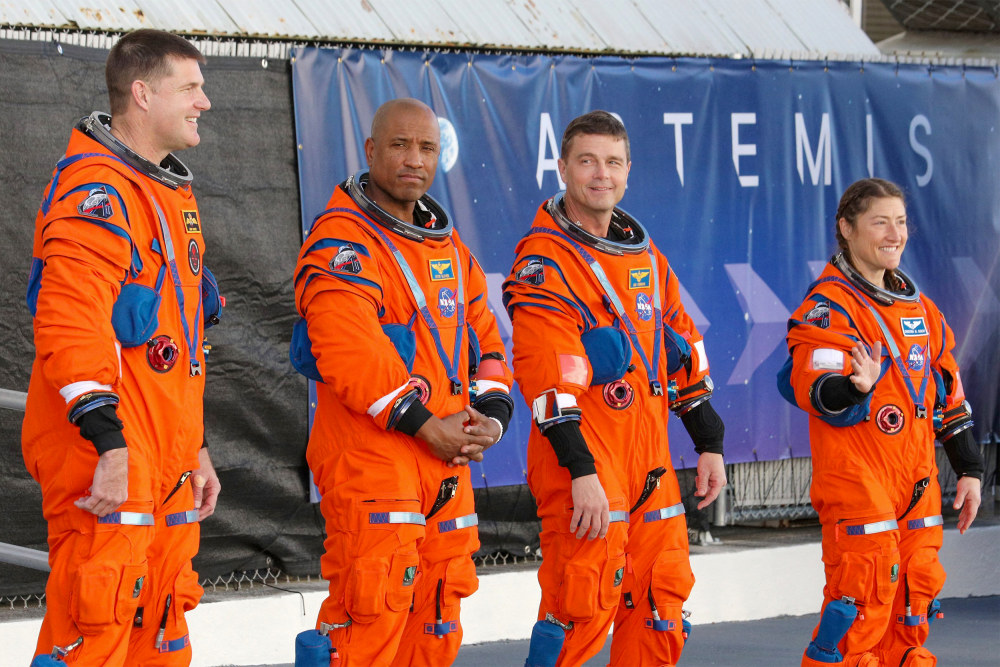
The Artemis II astronauts pause during a demonstration test at the Kennedy Space Center in Cape Canaveral, Fla., on Saturday.Gregg Newton / AFP via Getty Images
Aside from the geopolitical effects, the Artemis II mission aims to initiate a new phase of space exploration, with the objective of ultimately creating facilities for extended stays on the moon before astronauts eventually travel to Mars.
For certain scientists, the thrill of going back to the moon arises from the potential to explore lasting enigmas regarding its formation and evolution—like the intense collisions in the early solar system that formed it and the source of its water—topics that gained attention during the Apollo missions in the 1960s and 1970s.
“Lunar scientists have had many unanswered questions for decades, as you can imagine,” stated Brett Denevi, a planetary scientist at the Johns Hopkins University Applied Physics Laboratory in Laurel, Maryland.
According to Denevi, addressing some of those inquiries could reveal insights into comparable processes that took place during the formation of our planet.
"Earth isn't the best at keeping records," she stated. “Plate tectonics and weather have completely obliterated its earliest history.” However, on the moon, there exists this landscape that developed roughly 4.5 billion years ago, and it remains exposed on the surface for us to investigate.
Even though the Artemis II mission won't touch down on the moon, it will evaluate multiple technologies, docking techniques, and life-support systems — initially in Earth's orbit and subsequently in lunar orbit — which are crucial for upcoming missions.
NASA earlier sent the Space Launch System rocket along with the Orion capsule on an uncrewed lunar test flight — the Artemis I mission — lasting 3 1/2 weeks in 2022.
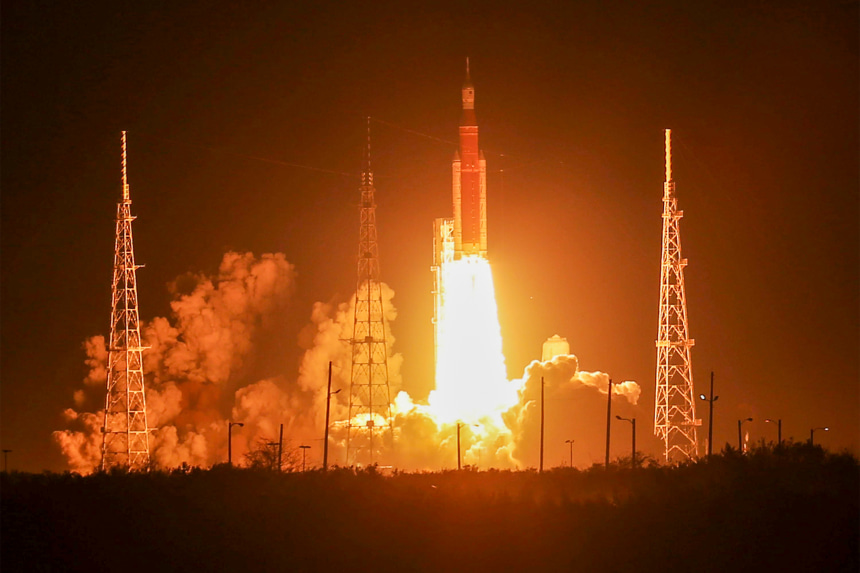
NASA's Artemis I Space Launch System rocket, with the Orion capsule attached, launches toward the moon in 2022 from NASA's Kennedy Space Center in Cape Canaveral, Fla.Red Huber / Getty Images
The space agency aimed to launch Artemis II in 2024, but expensive setbacks continually delayed it and the following missions.
"Much depends on this, both positively and negatively," stated Casey Dreier, head of space policy for The Planetary Society, a nonprofit that engages in research, advocacy, and outreach to support space exploration. "Everything appears to be aligning, but this is the first instance of humans aboard this rocket, and we have never trialed this life-support system in space previously."
A specific launch date has not been revealed, but it is anticipated to occur between February and April. Aboard the spacecraft will be NASA astronauts Reid Wiseman, Victor Glover, and Christina Koch, along with Canadian Space Agency astronaut Jeremy Hansen.
The group of four was chosen for the task in 2023. Wiseman, Glover, and Koch will embark on their second journeys into space, whereas Hansen will be taking his first flight into space.
Over the weekend, the astronauts finished an important launch-day practice, where they wore their flight suits, entered the Orion spacecraft, and went through the countdown procedure up to the moment right before takeoff.
The Artemis initiative was launched during the first Trump administration in 2019, repurposing the Space Launch System rocket and Orion capsule from earlier halted or scrapped NASA projects. The space agency began developing a next-generation booster in 2010, one year prior to retiring the space shuttles. The Orion spacecraft was initially developed for the Constellation Program, created by President George W. Bush to carry out manned missions to the moon and Mars.
Last week, Trump reinforced his moon return initiative through an executive order instructing NASA to focus on “enhancing human exploration and American presence in space” by landing astronauts on the moon by 2028
Artemis II aims to set the stage for the Artemis III mission in 2027, which plans to land four astronauts close to the moon’s south pole, an area significantly different from where the Apollo astronauts made their footprints.
While the Apollo moon landings took place in a limited area near the moon's equator, the south polar region presents greater challenges for landing due to its cratered terrain. These basins, which are always in shadow, are believed to contain significant amounts of water ice, a valuable asset for creating a sustainable presence on the moon and for upcoming manned missions further into the solar system.
“Apollo provided us with the structure to comprehend the moon,” Denevi stated, “and now we possess the basis to pose new inquiries.”
Denevi heads the geology team for the Artemis III mission, a position that includes determining where the crew will explore after landing, what fieldwork they will undertake, and which samples they will gather to take back. Her main focus is on specimens collected from the moon's shadowy craters, which rank among the coldest locations in the solar system


Comments
Post a Comment